
Properties in Gurugram




Table of Contents
Key Takeaways :
- Delhi Dehradun Expressway opening date: 14 April, 2026, inaugurated by Prime Minister Narendra Modi
- Official Name: Delhi–Saharanpur–Dehradun Economic Corridor
- National Highways: NH-709B, NH-307, NH-344G
- Length: 210–213 km | Total cost: ₹11,963–₹13,000 crore (under Bharatmala Pariyojana)
- Construction Agency: National Highways Authority of India (NHAI), built on an Engineering, Procurement and Construction (EPC) model, with individual packages awarded to contractors including Gawar Construction, Krishna Constructions, and Shiv Build India
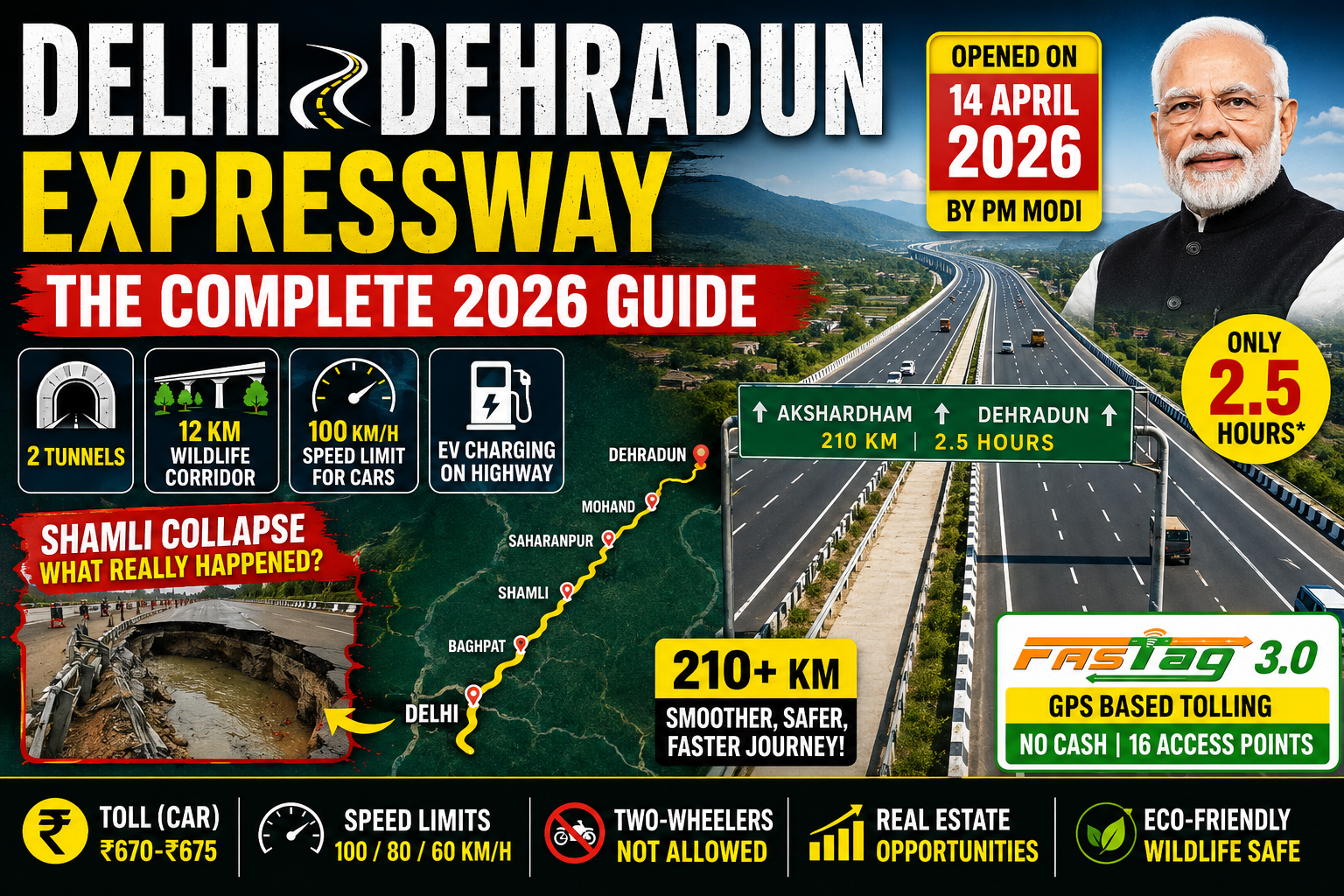
The Delhi Dehradun Expressway is a 210 km long access-controlled road that opened on April 14, 2026, under PM Narendra Modi.
The Delhi to Dehradun Expressway reduces travel time from 5–6 hours to 2.5 hours, has the world’s longest elevated corridor for wildlife, and employs the FASTag 3.0 tolling system using GPS technology through 16 access points.
The दिल्ली – देहरादून एक्सप्रेसवे has made a remarkable difference in North India travel.
This guide will help you understand everything about the delhi dehradun expressway — the route map, delhi dehradun expressway village list, toll rates, speed limits,
the delhi dehradun expressway collapse near Shamli, the wildlife corridor, real estate along the corridor, EV charging, and the latest delhi dehradun expressway news, all in one place.
Delhi Dehradun Expressway Route & Phase Breakdown
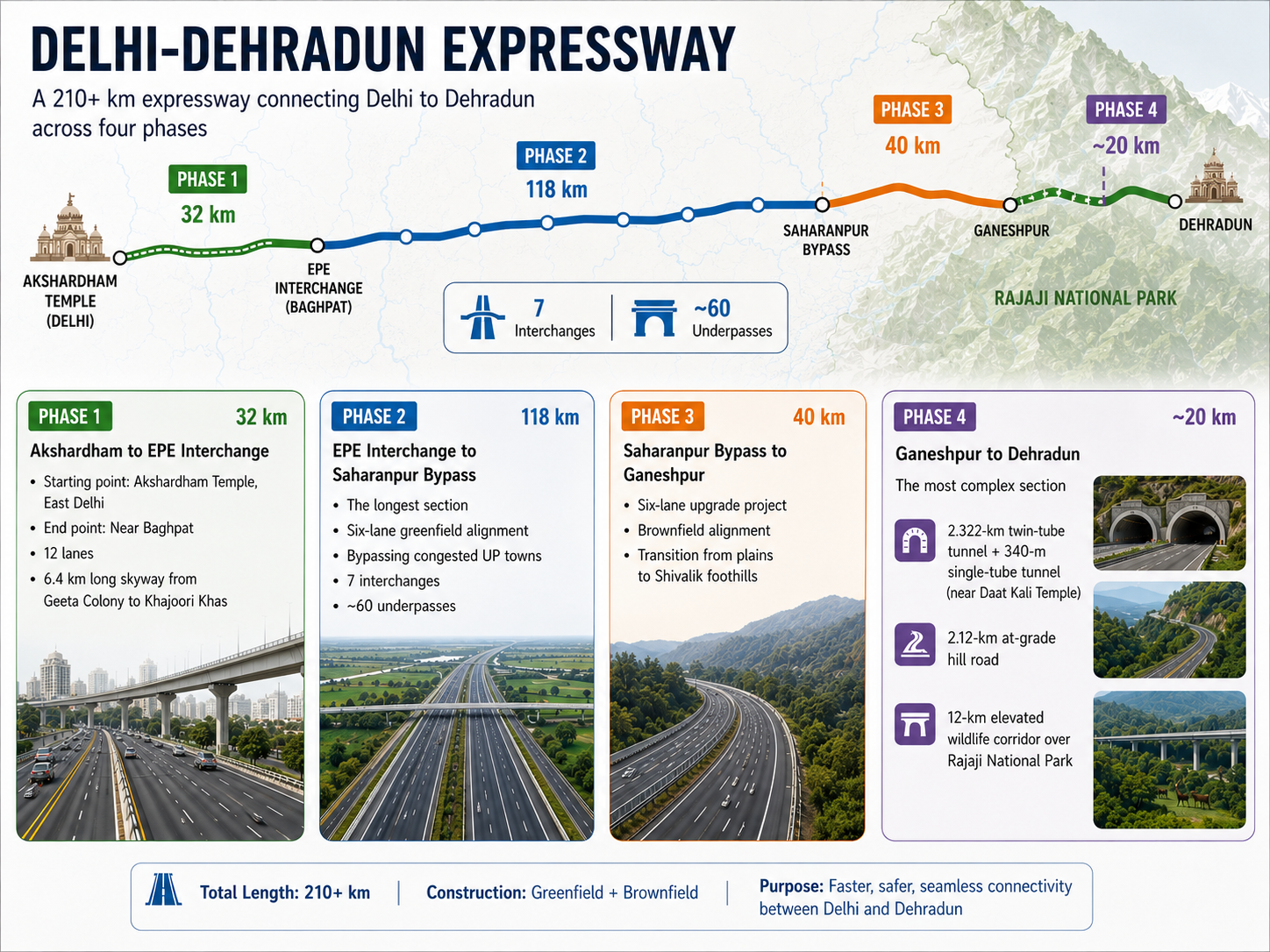
The delhi dehradun expressway route involves both greenfield and brownfield construction across four phases.
Phase 1 — Akshardham to EPE Interchange (32 km)
Starting point is Akshardham Temple in East Delhi, end point near Baghpat. Has 12 lanes, and a 6.4 km long skyway from Geeta Colony to Khajoori Khas.
Phase 2 — EPE Interchange to Saharanpur Bypass (118 km)
The longest section. A six-lane greenfield alignment bypassing congested UP towns, with 7 interchanges and ~60 underpasses.
Phase 3 — Saharanpur Bypass to Ganeshpur (40 km)
A six-lane upgrade project on a brownfield site, moving from the plains to the Shivalik foothills.
Phase 4 — Ganeshpur to Dehradun (~20 km)
The most complex section, featuring:
- 2.322-km twin-tube tunnel + 340-m single-tube tunnel (near Daat Kali Temple)
- 2.12-km at-grade hill road
- 12-km elevated wildlife corridor over Rajaji National Park
Delhi Dehradun Expressway Route Map & Village List
Planning your trip? This route map delhi dehradun expressway village list breakdown covers every major stop from Delhi to Dehradun, so you know exactly what’s ahead before you set out.
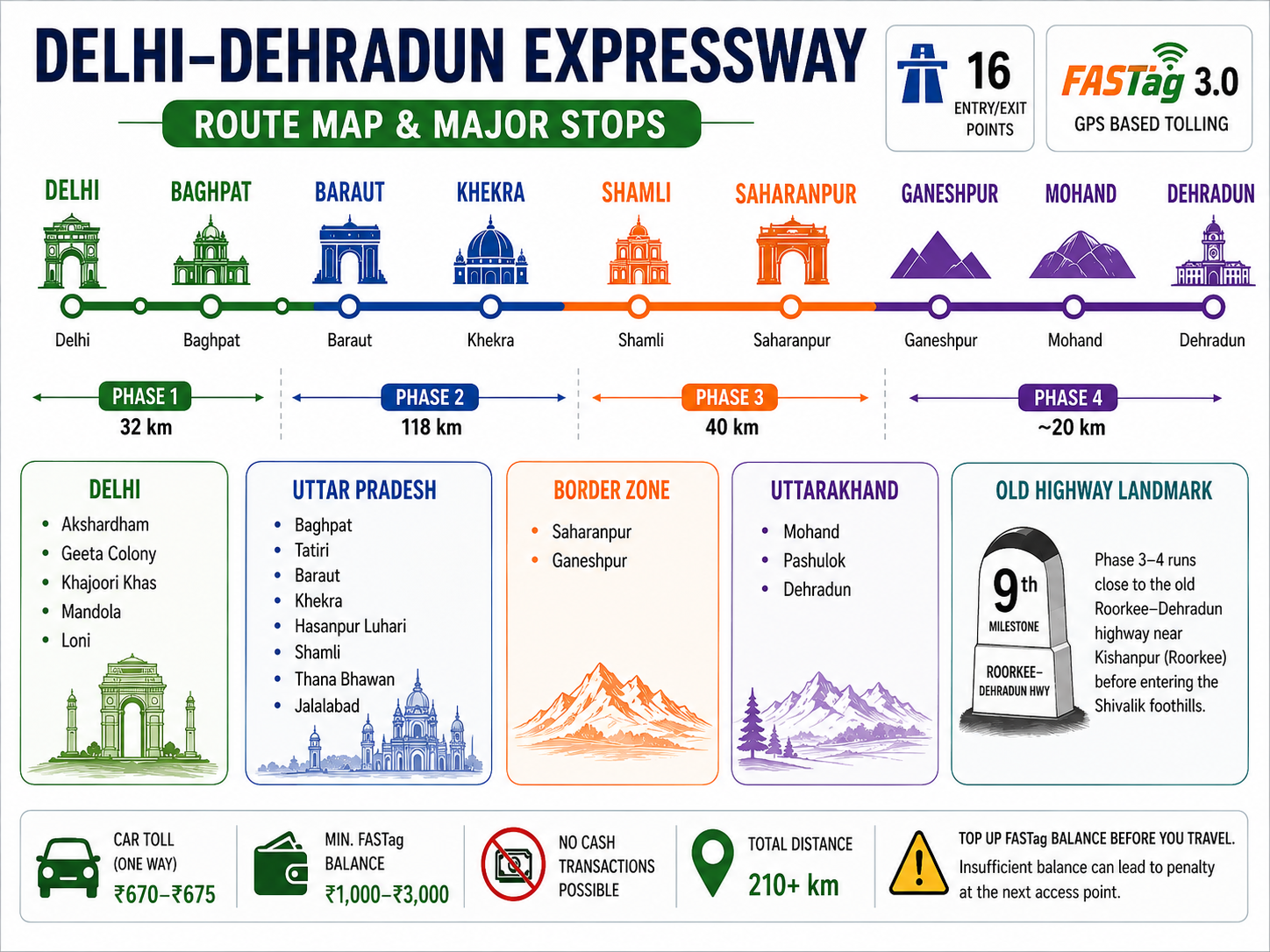
The delhi dehradun expressway route map travels through:
Delhi → Baghpat → Baraut → Khekra → Shamli → Saharanpur → Ganeshpur → Mohand → Dehradun
Key locations along the delhi dehradun expressway village list:
- Delhi: Akshardham, Geeta Colony, Khajoori Khas, Mandola, Loni
- Uttar Pradesh: Baghpat, Tatiri, Baraut, Khekra, Hasanpur Luhari, Shamli, Thana Bhawan, Jalalabad
- Border Zone: Saharanpur, Ganeshpur
- Uttarakhand: Mohand, Pashulok, Dehradun
Old highway landmark to know: If you’re used to the older road, the well-known 9th Milestone, Roorkee-Dehradun Highway locality near Kishanpur village (Roorkee) sits on the pre-existing Roorkee–Dehradun route.
The new expressway’s Phase 3–4 stretch runs close to this corridor before climbing into the Shivalik foothills toward Ganeshpur and Mohand — useful to know if your GPS or an old address still references it.
Looking for a dehradun expressway map before you travel? Keep the FASTag 3.0 entry/exit points in mind — there are 16 of them along the full 210 km stretch, so plan your on/off ramps in advance.
Toll Charges & FASTag 3.0
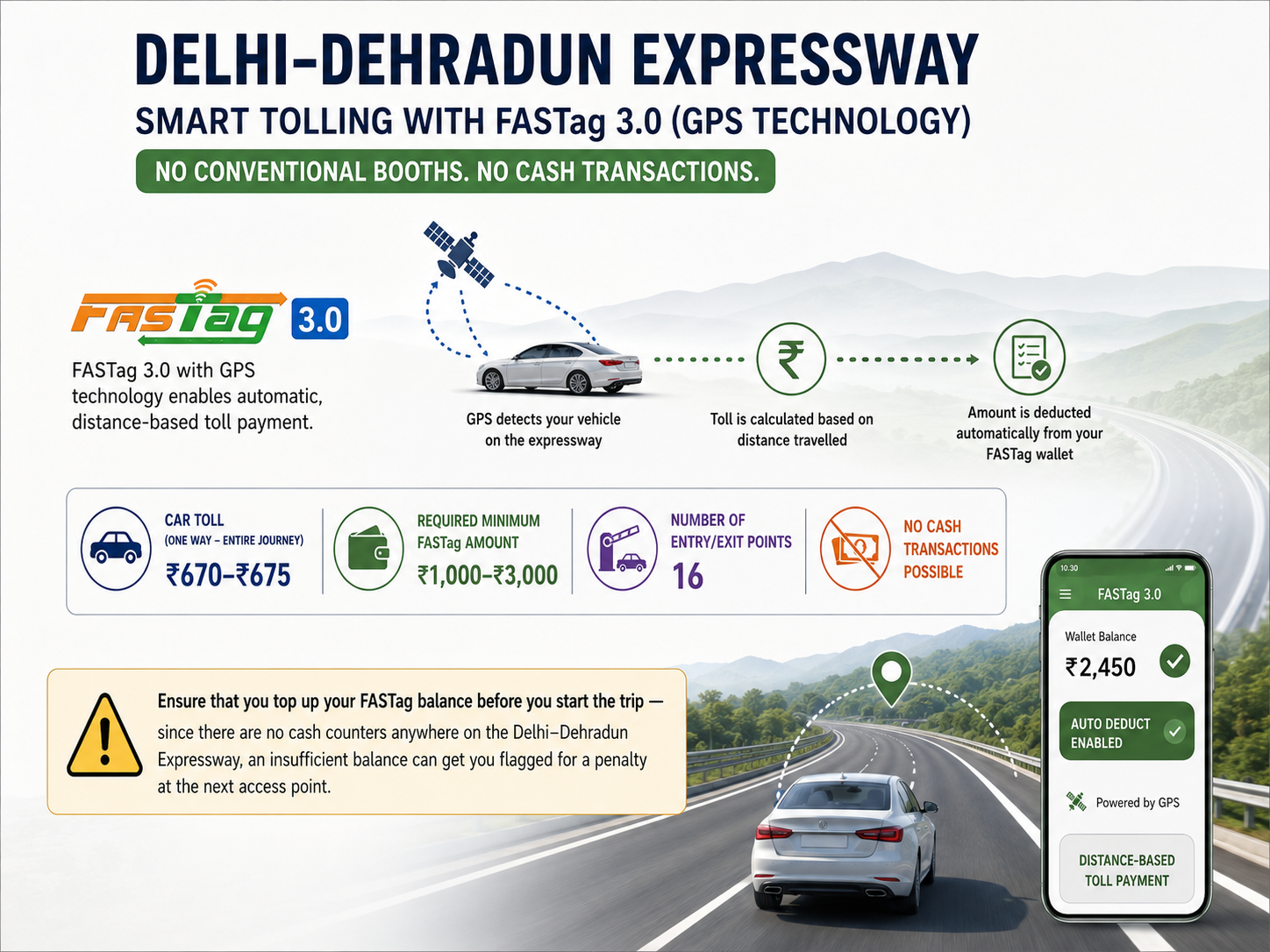
No conventional booths. FASTag 3.0 with GPS technology enables automatic, distance-based toll payment.
- Car toll for one way (entire journey): ₹670–₹675
- Required minimum FASTag amount: ₹1,000–₹3,000
- Number of entry/exit points: 16 | No cash transactions possible
Ensure that you top up your FASTag balance before you start the trip — since there are no cash counters anywhere on the delhi dehradun expressway, an insufficient balance can get you flagged for a penalty at the next access point.
Speed Limits & Rules
Enforced by an ATMS (Automatic Traffic Management System) with cameras linked to the national e-challan database.
| Zone | Speed Limit |
|---|---|
| Light motor vehicles | 100 km/h |
| Heavy commercial vehicles | 80 km/h |
| Wildlife corridor (Rajaji NP) | 60 km/h |
| Minimum speed | 60 km/h |
Key rules:
- No horns, no parking, headlamps on at night — within the wildlife corridor.
- Forbidden vehicles: two-wheelers, auto-rickshaws, tractors, and animal-drawn carts (except two-wheelers traveling along the 12-km Mohand stretch, capped at 60 km/h).
- Vehicles carrying heavy loads: left lanes only during peak hours.
Delhi Dehradun Expressway Collapse — What Happened Near Shamli
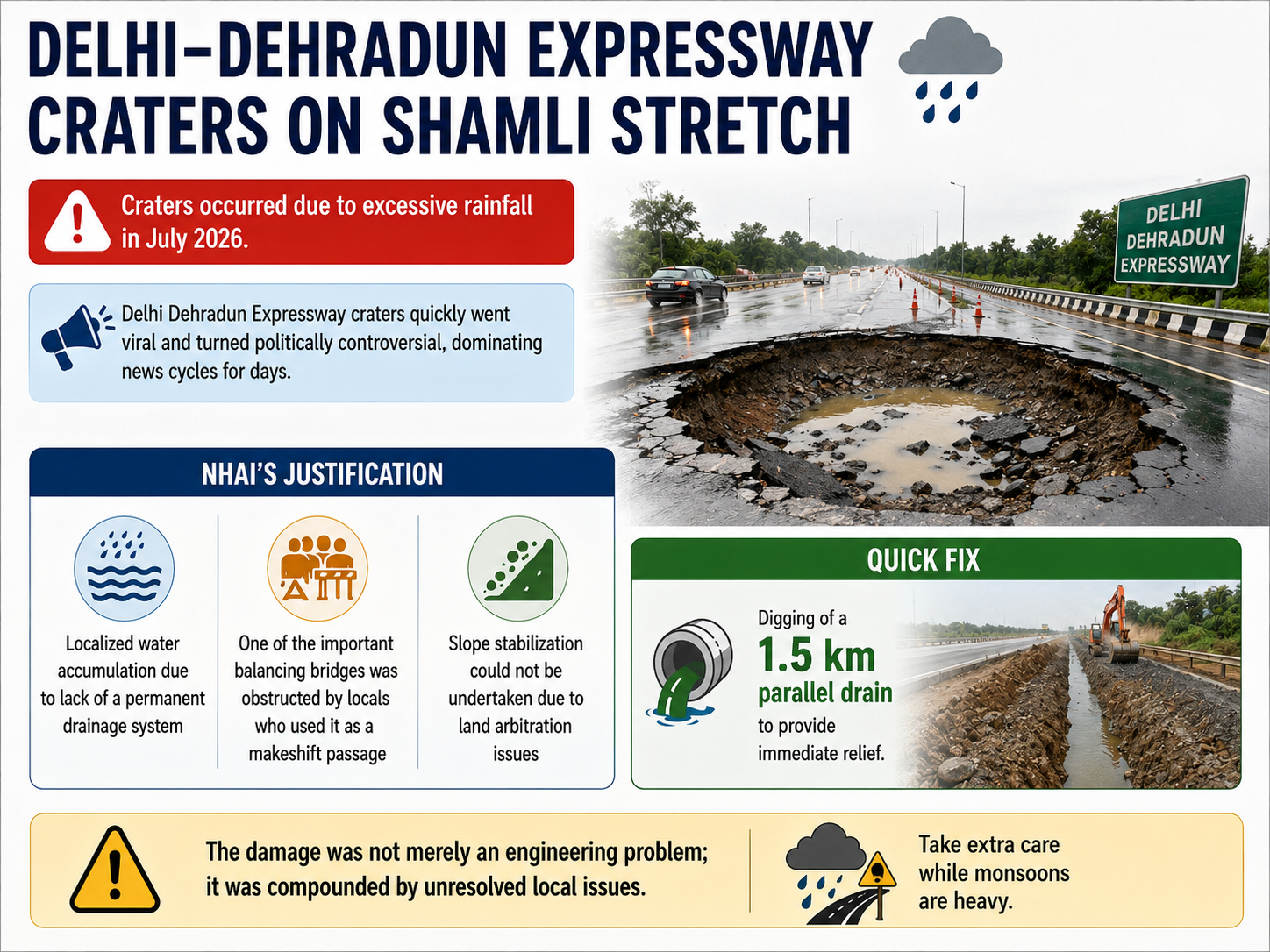
The craters occurred on the Shamli stretch due to excessive rainfall in July 2026. The delhi dehradun expressway craters quickly went viral and turned politically controversial, dominating delhi dehradun expressway news cycles for days.
NHAI’s justification:
- Localized water accumulation due to lack of a permanent drainage system
- One of the important balancing bridges was obstructed by locals who used it as a makeshift passage
- Slope stabilization could not be undertaken due to land arbitration issues
Quick fix: Digging of a 1.5 km parallel drain to provide immediate relief.
The damage was not merely an engineering problem; it was compounded by unresolved local issues. Take extra care while monsoons are heavy.
Wildlife Corridor & The Ecological Paradox
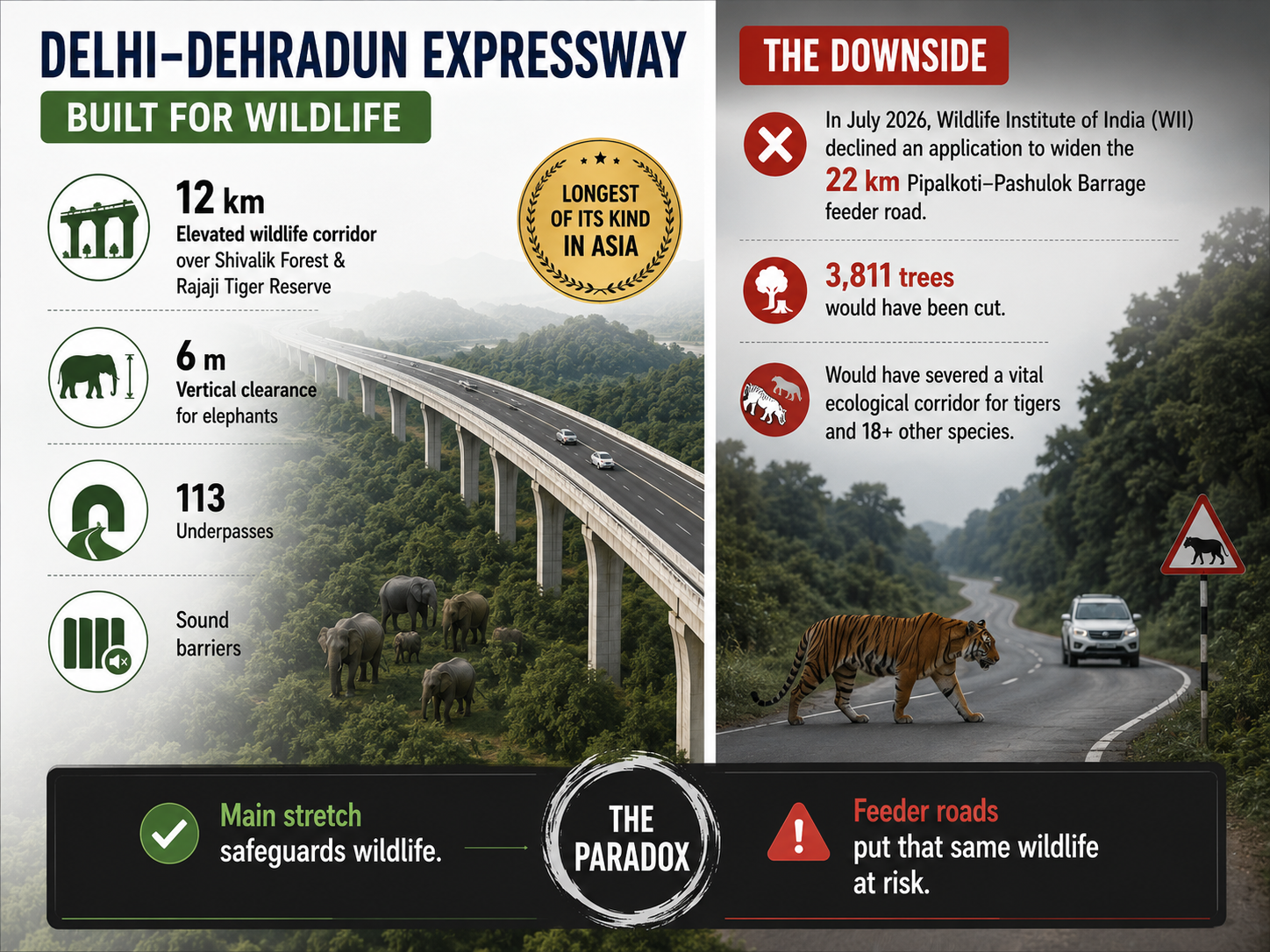
The most prominent feature of the expressway is a 12-kilometer elevated corridor for wildlife that spans the Shivalik Forest and Rajaji Tiger Reserve — said to be the longest of its kind in Asia.
It maintains a vertical clearance of 6 meters for elephants, along with 113 underpasses and sound barriers.
However, there is a downside. In July 2026, the Wildlife Institute of India (WII) declined an application to widen the 22-kilometer-long Pipalkoti-Pashulok Barrage feeder road, since it serves as a movement corridor for tigers, among 18 other species.
That project could have cost 3,811 trees and severed a vital ecological corridor.
The road safeguards wildlife on its main stretch, but its feeder roads put that same wildlife at risk. This paradox still persists.
Delhi to Dehradun Expressway vs Other Transport Options
| Transit Mode | Total Cost (4 Pax) | Per Person | Door-to-Door Time |
|---|---|---|---|
| Personal Car (Expressway) | ~₹2,020 (toll + fuel) | ~₹505 | ~2.5 hrs |
| UTC Volvo Bus | ~₹2,836 | ~₹709 | ~4 hrs |
| Vande Bharat (AC Chair) | ~₹4,300 | ~₹1,075 | ~5.5 hrs |
| Domestic Flight (Economy) | ~₹14,000+ | ~₹3,500+ | >5 hrs |
(Fuel: ~14.2 L @ ₹94.77/L for a 15 km/L vehicle)
Traveling by car with a family of four on the delhi to dehradun expressway costs just ₹505 per head — less than half the Vande Bharat fare, and it gets you there roughly two hours faster. Solo travelers should consider the UTC Volvo bus (₹709, 4 hours) instead.
Kanwar Yatra & Seasonal Restrictions
Policy Change During Kanwar Yatra (July–August)
For the 2026 Kanwar Yatra, the expressway was declared entirely out-of-bounds for all Kanwar pilgrims, whether walking or using Dak Kanwar transport.
- Dak Kanwar transport → old Delhi–Haridwar Highway
- Walking pilgrims → Upper Ganga Canal route
- ITBP, SSB, CRPF, and NDRF man check posts at the Uttarakhand state border
- All pilgrims must carry valid ID proof; weapons are not allowed
Normal vehicle movement continues on the delhi dehradun expressway, but expect heavy security at access roads and interchanges.
Heavy transport can be stopped by the district magistrate at any time. Factor in extra travel time during Panchak days (late July–early August).
Real Estate Along the Expressway Corridor
| Micro-Market | Primary Driver | Price (Per Sq. Ft.) | Projected Appreciation |
|---|---|---|---|
| Baghpat (Phase 1–2) | Logistics, warehousing | ₹3,000–₹4,000 | 18%–22% |
| Shamli (Phase 2) | Industrial, agrarian conversion | ₹2,800–₹3,500 | 15%–20% |
| Saharanpur (Phase 3) | Hospitality, commercial plots | ₹4,500–₹6,000 | 12%–18% |
| Dehradun fringes (Doiwala) | Farmhouses, eco-resorts | ₹3,500–₹6,000 | 20%–25% |
| Dehradun core (Rajpur Road) | Luxury villas, high-rise | ₹8,500–₹14,000 | High premium |
There is one drawback, however: old highway towns such as Hasanpur Luhari in Shamli have seen traffic drop by over 50%.
The dhabas, hotels, and petrol pumps that once stayed open all night are now largely empty.
EV Charging Infrastructure
On the highway: NHEV-compliant Wayside Amenities (WSAs) from PATH Recharge offer fast DC and AC charging, alongside food courts, dormitories, and repair stations.
In Dehradun (48+ stations):
| Operator | Key Locations | Connector Types |
|---|---|---|
| Tata Power | Pacific Mall (Rajpur Rd), Nanda Ki Chowki | CCS-II, CHAdeMO, AC Type 2 |
| Statiq | Centrio Mall, IT Park, Hotel City Green (ISBT) | DC Fast, AC Fast |
| Ather Energy | Nine Mountains Motors (Jogiwala), Sahastradhara Rd | Proprietary, AC |
| Indian Oil (IOCL) | Transport Nagar, Bhaniawala, Dehrakhas | CCS-II, AC, 3-Pin |
Check charger availability before departure — popular spots like Pacific Mall fill up on weekends.
Spur Expressways & Future Extensions
The delhi dehradun expressway is part of a broader network:
- Saharanpur–Roorkee–Haridwar Spur (50.7 km): Cuts Delhi–Haridwar travel time to about 3 hours; connects to the Char Dham Highway (Kedarnath, Badrinath, Gangotri, Yamunotri)
- Ambala–Shamli Expressway (121 km): Links Haryana and UP; connects to the Bareilly–Ludhiana Economic Corridor, letting freight bypass the NCR
- Dehradun–Mussoorie Elevated Expressway (26 km, ₹6,100 crores): Proposed by Union Minister of Road Transport and Highways Nitin Gadkari, to ease chronic tourist congestion on the Dehradun–Mussoorie stretch
Frequently Asked Questions
1. What is the Delhi Dehradun Expressway opening date? April 14, 2026, inaugurated by PM Narendra Modi.
2. What is the total length of the delhi dehradun expressway? Approximately 210–213 km, from Akshardham, Delhi to Dehradun.
3. What is the toll for a car? ₹670–₹675 one-way for the full route, deducted via FASTag 3.0.
4. Are two-wheelers allowed? No, except on the 12-km Mohand elevated section at a maximum of 60 km/h.
5. What caused the delhi dehradun expressway collapse near Shamli? Localized waterlogging from an incomplete drainage system, worsened by local disputes. NHAI dug a 1.5-km emergency drain as a temporary fix.

Join The Discussion