
Properties in Gurugram




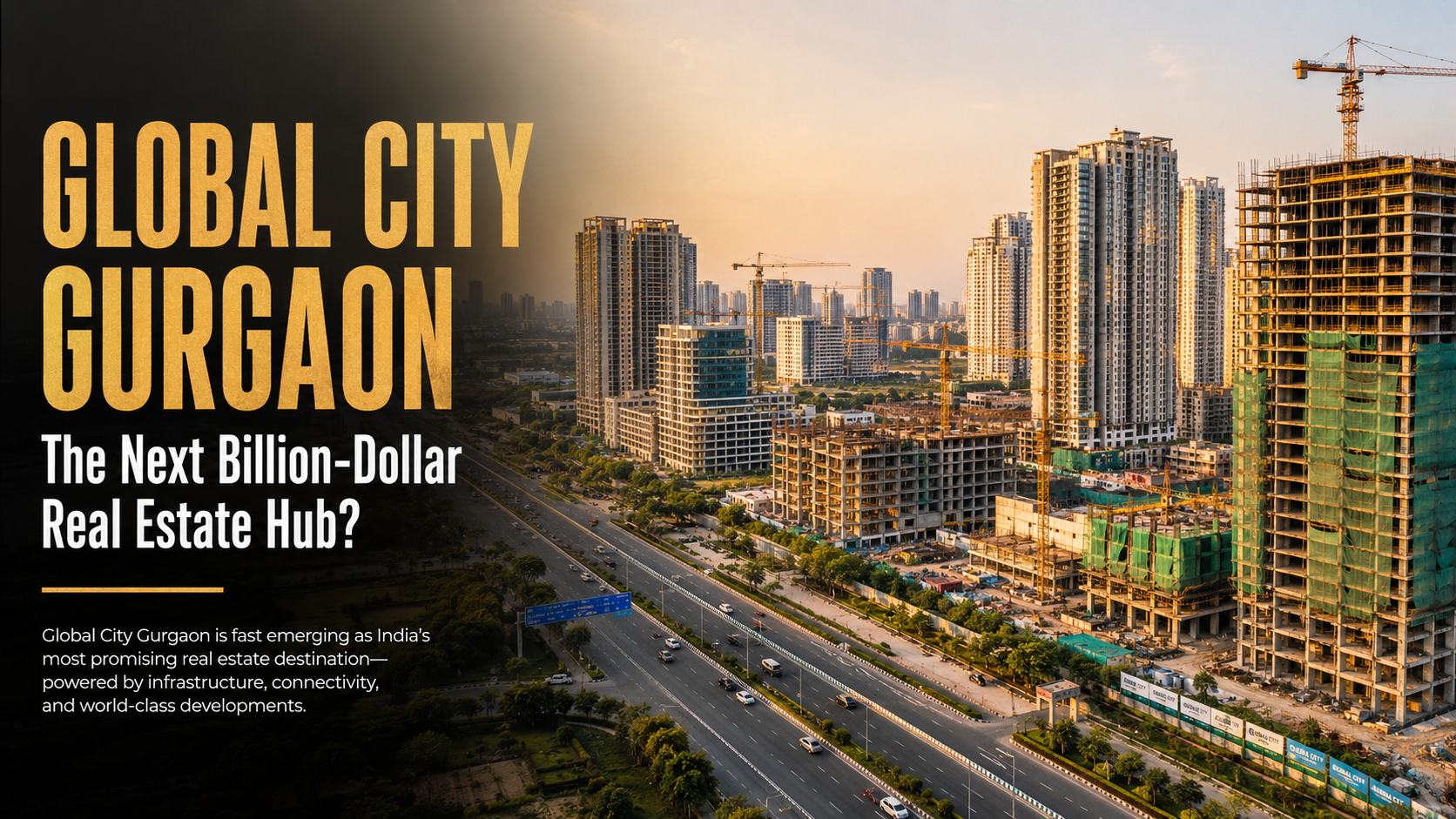
Quick answer: Global City Gurgaon is a 1,003-acre state-sponsored development project that was developed by the Haryana State Industrial and Infrastructure Development Corporation (HSIIDC). The $15 billion development project consists of 3.0 Floor Area Ratio, subterranean utilities tunneling, and waste automation to facilitate a central business district akin to Singapore’s Marina Bay district.
There have been significant changes in the way urbanization is taking place in the National Capital Region. Traditionally, the growth process was marked by fragmented and decentralised property development, thereby creating numerous problems, among which was congestion and a lack of sufficient utility services. In order to address these problems arising from the existing urban setup, the Haryana State Industrial and Infrastructure Development Corporation (HSIIDC) conceived Global City Gurgaon. It seeks to develop an integrated central business district.
Global City Gurgaon is strategically located on the rapidly growing eight-lane Dwarka Expressway. The entire project is worth an estimated ₹1.2 lakh crore ($15 billion). It aims at developing an integrated central business district with the capacity to compete internationally. Benchmarking has been done with respect to international financial districts such as Singapore’s Marina Bay and Dubai’s Business Bay.

What defines the spatial architecture and master plan of Global City Gurgaon?
The spatial architecture of Global City Gurgaon represents an institutional-grade land allocation framework designed to regulate urban density and maintain environmental equilibrium. Rather than allocating small, fragmented plots to individual retail buyers, the HSIIDC auctions land in massive multi-use and residential blocks to tier-one developers.
- Regulate vertical density across the entire development zone
- Mandate open spaces and ecological corridors
- Ensure uniform architectural quality among corporate developers
- Prevent visual and infrastructural dissonance
This is a vast development on an area measuring 1,003 acres spread across sectors 36, 36B, 37, 37A, and 37B. One of the important parts of the master plan is the permission of a 3.0 Global Floor Area Ratio (FAR). In the realm of urban planning, the FAR determines the amount of building floor area in relation to the extent of the land parcel. By allowing for a very high ratio of 3.0, the government is allowing for high verticality. High verticality will release a lot of ground area square footage for the strict adherence to the rules regarding open spaces. As such, the spatial design has reserved 56% of the entire land area for open spaces. After the project is completed, the total area covered by buildings will be more than 120 lakh square meters. The residential areas are specifically designed to have a fixed population of 1.8 lakh people, whereas the commercial centers will have a floating population of 5.2 lakh people.

How does subterranean engineering function in Global City Gurgaon?
Subterranean engineering refers to the highly specialized sub-surface infrastructure designed to maintain municipal utility operations without causing surface-level disruptions. Traditional urban maintenance suffers from a destructive cycle wherein paved roads are continuously excavated to repair utilities.
- House utility networks securely beneath the road surface
- Transport waste materials through pneumatic systems
- Manage hydrological cycles to prevent urban flooding
- Eliminate surface-level maintenance disruptions
This Common Utility Tunnel runs for a total distance of 10.5 km and has dimensions of 5.5 m x 5.5 m underground concrete tunnel. This tunnel enables maintenance people from the city to enter inside the tunnels and perform repair works on the water pipes, fiber optics for communication, and electrical cables without causing any disruption to the traffic on the road. Moreover, the waste management system makes use of Automated Vacuum Waste Collection (AVWC) system that does not make use of garbage trucks that depend heavily on diesel. In this method, refuse is transported to the facility via underground pipelines that move at a velocity of up to 70 km/hr. Finally, the water management system relies on SCADA Monitoring System. The key aspect of this ecological masterpiece is the Aqua Sponge, which is the main freshwater lake that can accommodate huge amounts of rainwater.

What are the micro-climate engineering and ESG standards in Global City Gurgaon?
Micro-climate engineering involves localized environmental modifications intended to reduce the urban heat island effect and optimize long-term energy consumption across the township. The environmental design of the project adheres to strict Environmental, Social, and Governance (ESG) principles.
- Lower ambient temperatures through natural canopy expansion
- Reduce HVAC loads on surrounding commercial towers
- Adhere to international green building standards
- Minimize the overall carbon footprint of the urban center
Strategic planting of 1 lakh grown up trees, along with vast grass pavers and the central water pond, will help reduce the local ambient temperature by 5°C through mathematical calculations. This reduction in the local temperature will address the problem of the urban heat island effect, significantly minimizing the use of air conditioners in corporate offices. All architectural constructions must comply with the standards of LEED, GRIHA, and IGBC green buildings. Installation of rooftop solar photovoltaics on community buildings will ensure that the township becomes a net zero energy township.

How is transit-oriented development executed within Global City Gurgaon?
Transit-Oriented Development (TOD) is an urban planning methodology that prioritizes high-efficiency mass public transit and pedestrian accessibility over private vehicular infrastructure. Mobility within Global City Gurgaon is strictly dictated by these principles, establishing a self-contained commuting ecosystem.
- Connect commercial and residential zones efficiently
- Integrate the central business district with regional transit networks
- Facilitate pedestrian mobility and active transportation
- Reduce reliance on private automobiles
The township has been carefully designed on the principles of being a 15-minute city, which means that the entire infrastructure of the city should be able to provide all daily necessities in less than a 15-minute walk or bicycle journey. The logistics in this regard include having a Mass Rapid Transit System (MRTS) line that covers six kilometers and has six transit stations. The urban planners have designed the algorithm in such a way that about 80% of the buildings are within 5 minutes’ walk of the transit station. This entire network of internal infrastructure is then connected through the 1.85-km Metro spur line with the Gurugram-Manesar-Panchgaon metro rail line. The regional connectivity is assured through the eight-lane Dwarka Expressway that gives one direct access to the IGI airport in 30 minutes.

What are the structural specifications for the tallest skyscraper in India?
The architectural anchor of the development is a designated 6.7-acre plot engineered specifically for a supertall mixed-use skyscraper. This monumental structure is officially poised to become the tallest building in India, serving as the supreme economic symbol of the project.
- Provide premium corporate headquarters for global enterprises
- House ultra-luxury hospitality suites and retail podiums
- Establish a globally recognized architectural silhouette
- Position the state on the international commercial map
Currently, in the stage of architectural consultancy, this super tall building is expected to have incredible heights ranging from 620 meters to 700 meters. Putting these heights into perspective, the highest building currently existing in Gurgaon is Trump Tower at a height of 201 meters, while the highest building in India is Palais Royale located in Mumbai at a height of 320 meters. The global city tower towers over both structures. The significance of this megastructure lies beyond mere real estate; it serves as a branding activity similar to the Marina Bay Sands of Singapore.
What are the official construction timelines for Global City Gurgaon?
The construction timeline operates on a phased delivery schedule managed by the HSIIDC to systematically execute civil infrastructure elements before vertical development begins. Execution velocity is a critical metric for institutional investors monitoring the project.
- Relocate existing electrical infrastructure
- Construct trunk infrastructure including roads and tunnels
- Initiate vertical development and corporate leasing
- Deliver fully serviced land parcels to developers
According to initial findings in early 2026, there are clear indicators that the development is progressing through the construction indicators which have been state regulated. The first and foremost de-risking activity is moving three high tension electricity power cables underground which are crossing the land, expected to be completed by August 2026. Moving the cables underground immediately makes way for vertical building in the area. Also, there is an expectation of completion of Phase I core trunk infrastructure, covering 587 acres, with a total tender worth of ₹940 crore, in December 2026.
How does Global City Gurgaon generate economic multipliers?
Economic multipliers refer to the macroeconomic ripple effects generated by corporate clustering, infrastructure investment, and state operational policies. The economic modeling behind the project is explicitly designed to elevate regional Gross Domestic Product substantially.
- Accelerate multinational corporate acquisition
- Generate comprehensive employment opportunities
- Expand regional service export volumes
- Attract institutional capital investments
HSIIDC has introduced a 14-day rapid clearance process that is intended to attract top Fortune 500 companies and technology companies. The elimination of bureaucratic hassles would ensure the addition of more than 200 companies in the corporate towers. Agglomeration effects from such corporate clustering are immense. The entire business model is designed in such a way as to create job opportunities for around 5.2 lakh individuals directly and indirectly. Moreover, the presence of Grade-A IT infrastructure would raise the service exports of Gurugram by about 30%.
What are the real estate market and pricing dynamics around Global City Gurgaon?
Real estate market dynamics in the surrounding sectors are characterized by significant capital appreciation driven by the catalytic infrastructure of the central business district. The formal execution of the project has triggered a massive recalibration of property valuations along the Dwarka Expressway corridor.
- Drive residential and commercial land valuations upward
- Establish premium micro-markets for luxury assets
- Supply affordable and mid-segment housing for support workforces
- Generate long-term rental yields for property investors
The average cost of real estate in the adjacent sectors stood at ₹7,500 per square feet in 2022. With regards to 2026, owing to the development in infrastructure in the sector, appreciation in terms of prices is estimated to be in excess of 100%. Sector 36A has been transformed into an ultra luxury segment wherein apartments are priced between ₹14,000 to ₹18,000 per square foot. On the other hand, Sector 37D offers mid/premium quality of housing through the DDJAY scheme at a price range between ₹15,000 to ₹20,000 per square foot. Raw lands on the Dwarka expressway range from ₹2.2 lakh to ₹2.8 lakh per square yards, whereas SCOs in Sectors 88 & 114 stand at ₹4.5 lakh to ₹6 lakh per square yards.
Strategic Investment Case for the Urban Development
The detailed master plan of Global City Gurgaon constitutes a macroeconomic intervention meant to reinvent urban governance, population density, and environmental sustainability. Moving from sprawled urbanization to verticalized master planning, the government is crafting a formidable system that guarantees a safe absorption of institutional investments. With its underground utility tunnels, automated waste systems, and mobility, the logistics of this city are guaranteed to operate effectively over decades. This, combined with the forthcoming completion of phase 1 facilities by December 2026, makes micro-markets around the project well suited for continuous capital growth and rental income increases.
In order to manage the intricacies of real estate markets around such a huge and lucrative $15 billion project, professional help is recommended. Make sure you get expert advice in order to secure your real estate investments. Reach out to an authorized consultancy now.
Frequently Asked Questions about Global City Gurgaon
Who is responsible for developing Global City Gurgaon?
The project is a state-backed initiative developed and managed entirely by the Haryana State Industrial and Infrastructure Development Corporation (HSIIDC). The state builds the core infrastructure, while tier-one private developers construct the vertical residential and commercial towers.
What is the projected timeline for Phase 1 completion?
Phase 1 trunk infrastructure, which includes the 10.5-kilometer common utility tunnel and internal 60-meter-wide roads, is officially targeted for completion by December 2026. The critical relocation of high-tension power lines is scheduled for August 2026.
How does the automated vacuum waste collection system work?
The Automated Vacuum Waste Collection (AVWC) system transports refuse from indoor inlets through underground pneumatic tubes at speeds up to 70 kilometers per hour. It delivers the waste to a centralized facility outside the city limits for automated sorting and recycling.
What is the total investment required for the project?
The ultimate projected investment for the entire 1,003-acre development over its multi-decade lifecycle is estimated at ₹1.2 lakh crore, which equates to approximately $15 billion.
Why have property prices increased in the surrounding sectors?
Property prices have appreciated by more than 100% since 2022 due to the macroeconomic concept of catalytic infrastructure. The imminent creation of 5.2 lakh jobs and the fast-tracking of 200 multinational companies have driven immense speculative and end-user demand in Sectors 36A, 37D, and along the Dwarka Expressway.

Join The Discussion