
Properties in Gurugram





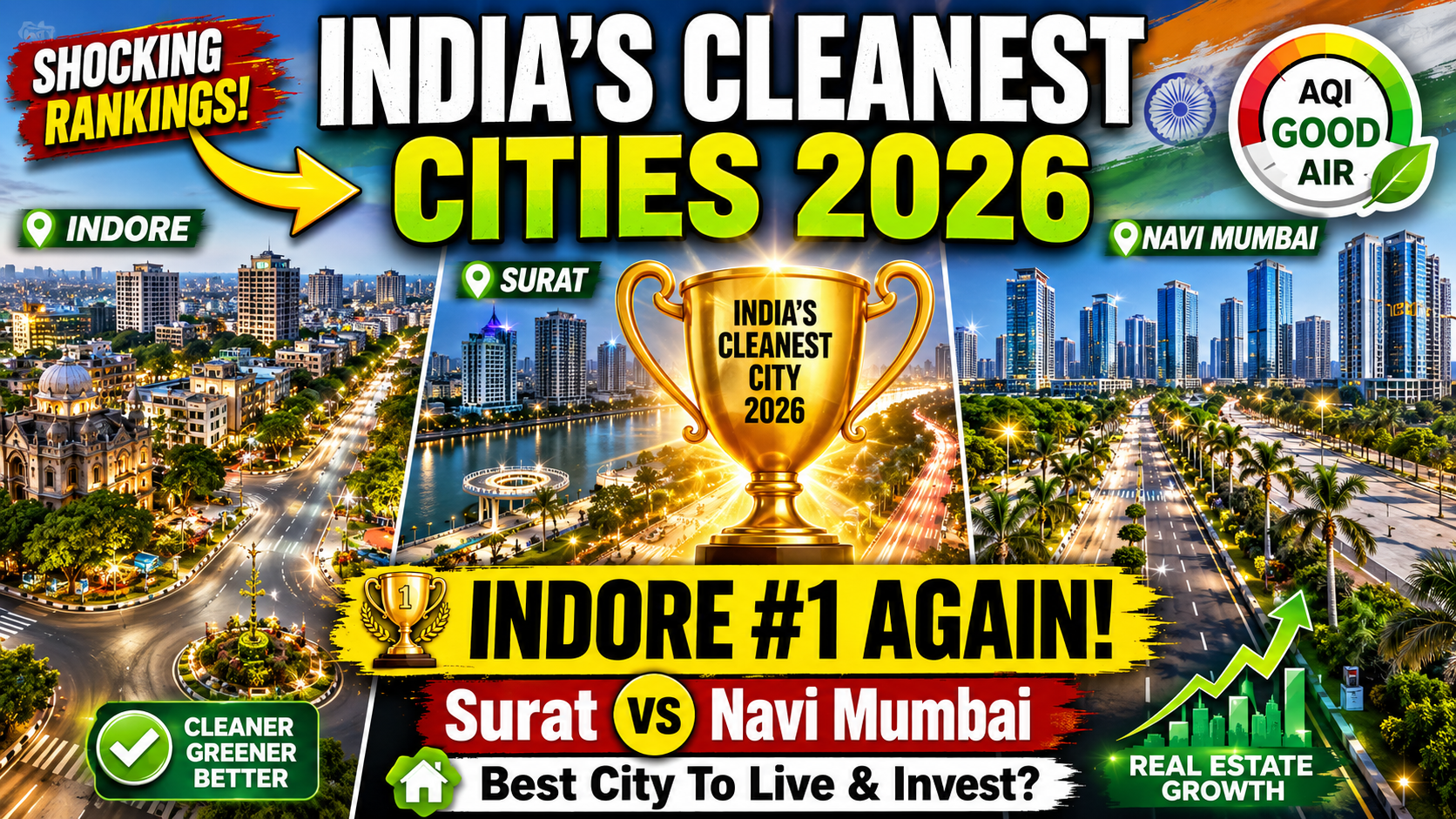
Having a spotless and efficiently run city as your new place to reside or invest is at the heart of the agenda of today’s smart home buyers. If you are interested in finding the cleanest cities of India in 2026, the figures indicate that there are three frontrunners that you will not want to ignore – these are Indore, Surat, and Navi Mumbai.
With impeccable municipal waste disposal policies in place, these cities provide an outstanding foundation for building quality infrastructure, maintaining excellent health standards, and developing real estate market.
For those interested in relocating to a cleaner city or choosing a city to visit, it is essential to understand the connection between the level of municipal hygiene and opportunities that it provides. The following information will explore Swachh Survekshan rankings and analyze various benefits provided by India’s cleanest cities.
What Makes a City Clean? Understanding the Swachh Survekshan Rankings
Before looking at the leading contenders, however, it is important to know how India judges its cities’ cleanliness. The ratings are based on the Swachh Survekshan survey carried out by the Ministry of Housing and Urban Affairs. This is the world’s largest urban sanitation survey.
The criteria for assessment are not only confined to cleaning up the streets but also include the city’s structural and civic mechanics. These include the following parameters:
Waste Segregation and Processing: How much waste the city processes daily and whether it is separated at the source.- Sanitation Infrastructure: The availability of waste-to-energy plants, mechanical sweepers, and the safety of sanitation workers.
- Citizen Feedback: How actively the local population participates in maintaining their environment.
This shows that if a particular city scores highly in the above rating, it is clear that the city is run by an efficient local authority. The efficiency will then permeate the area and result in healthy citizens, reduced incidences of floods resulting from drainage issues, and huge investments from corporations.
The Top Cleanest Cities in India for 2026: Lifestyle and Investment Breakdown
Now let us analyze the municipalities that have excelled in the Swachh Survekshan ranking and what makes them the best cities to live in India today..
1. Indore, Madhya Pradesh: The Undisputed Leader

The tradition of Indore continues to win, retaining its title of the cleanest city in India for yet another year. What helps them maintain their success is their highly efficient process of waste management involving 100% door-to-door garbage collection and handling more than 1,200 tons of solid waste per day. They were able to clear out huge heaps of accumulated waste in the past.
Lifestyle and Real Estate Takeaway: Civic success in Indore attracts people from all over India as well as investors. Clean streets with mechanical sweeping provide a nice environment for living. Infrastructure advantage leads to an increase in the number of homes. Areas such as Bicholi Mardana, Vijay Nagar, and AB Road Sector can be considered good real estate options because of the guaranteed quality environment.
2. Surat, Gujarat: The Diamond City's Transformation

Surat holds the number two rank owing to the fact that it handles an incredible amount of waste per day which totals up to 2,000 tons with a perfect segregation percentage of 98%. Surat utilizes sophisticated technology in order to convert waste into energy.
Lifestyle and Real Estate Takeaway: Surat is one of the largest centers in the world for diamond cutting and textile production. Surat’s nature as both an industrial center and a spotless city makes it very appealing for developers looking to invest in the area. Residential developments can be found in places like Palanpur and Athwa. The city is perfectly connected to places like Mumbai and Ahmedabad.
3. Navi Mumbai, Maharashtra: Planned Urban Perfection

Navi Mumbai is an excellent example of how effective pre-planning is for urban engineering projects. In contrast to old towns and cities where development occurred haphazardly, the roads in Navi Mumbai are wide and have huge open areas with greenery, as well as advanced treatment plants for solid waste which minimize the use of landfills.
Lifestyle and Real Estate Takeaway: Navi Mumbai is the ideal choice for investors and prospective buyers seeking a civilized environment away from the chaos of downtown Mumbai. Important investment spots such as CBD Belapur, Nerul, and Juinagar boast high property rates because of their beauty and ample park areas, which provide buyers with the luxury of residing in an efficient municipality.
4. Visakhapatnam, Andhra Pradesh: Coastal Charm Meets Civic Duty

Visakhapatnam takes fourth place because of its success in combining its scenic coastal location with strict urban governance. Thousands of employees specialize in coastal and urban cleaning in this city, where over 1,100 tons of waste per day is processed efficiently.
Lifestyle and Real Estate Takeaway: The city of Vizag is growing at an exponential rate due to the fast development in the Information Technology and pharmaceutical industry sectors. The industrial development of the city, along with its beautiful beaches and neat surroundings, is making its micro-markets very profitable. Industrial areas such as Yendada and Seethammadhara have seen a lot of multistory building construction for Information Technology professionals.
5. Bhopal, Madhya Pradesh: The City of Lakes

The list is topped off with Bhopal, which segregates 90% of 1,000 tons of waste processed everyday in an efficient manner. It concentrates more on recycling techniques and less on dumping wastes in landfills, thus protecting its famous lakes and nature surrounding areas from pollution caused by waste dumping.
Lifestyle and Real Estate Takeaway: A quiet life in Bhopal is more peaceful than that in a large metropolis. The real estate in the Upper Lake area and other developed parts of the city can immensely gain from Bhopal’s effort in retaining its beauty despite its modern sanitation system.
Frequently Asked Questions (FAQ)
1. Which is the cleanest city in India in 2026?
Indore continues to hold the title of the cleanest city in India. It achieves this through a flawless 100% door-to-door waste collection system, 100% waste segregation at the source, and the daily processing of over 1,200 tons of solid waste. Surat and Navi Mumbai closely follow in the second and third positions.
2. How does city cleanliness affect real estate property value?
There is a direct connection between civic sanitation and property rates. Clean cities attract better corporate investments, IT parks, and infrastructure projects. This economic boom brings in professionals who need housing, driving up demand. Furthermore, well-maintained roads and public spaces make neighborhoods more desirable, steadily pushing up long-term property valuations.
3. What is the Swachh Survekshan?
Swachh Survekshan is an annual survey conducted by the Ministry of Housing and Urban Affairs in India. It ranks cities based on their performance in urban sanitation. The survey evaluates municipalities on parameters like solid waste management, waste segregation, infrastructure development, and active citizen feedback.
4. Do AQI and city cleanliness mean the same thing?
No, they measure two different things. Official cleanliness rankings (like Swachh Survekshan) measure how well a city handles solid waste, street sweeping, and garbage disposal. The Air Quality Index (AQI) measures atmospheric pollution, such as particulate matter (PM2.5) from vehicles and industries. While clean streets help reduce dust, a city can have excellent waste management but still face seasonal air quality challenges.



Join The Discussion